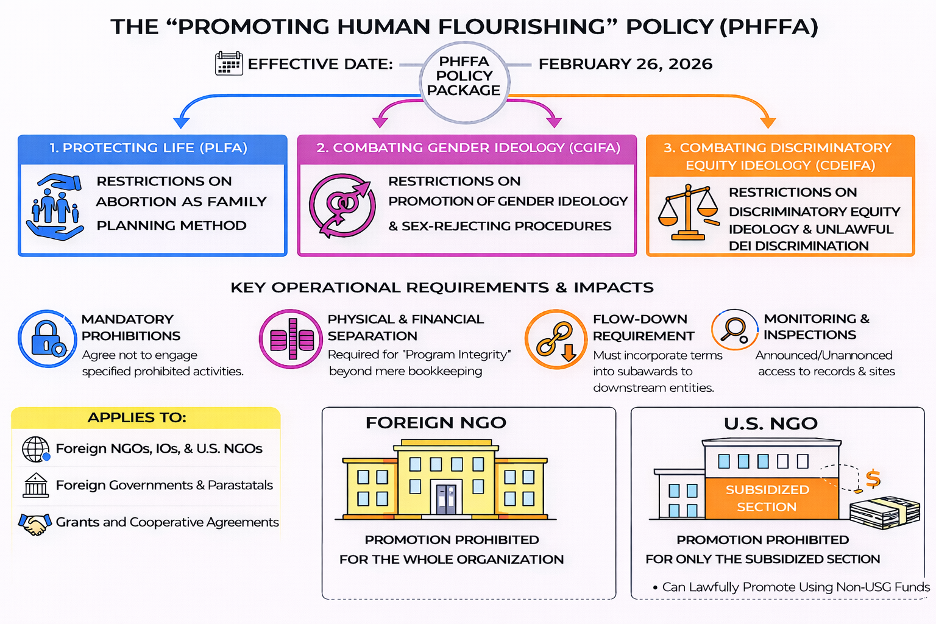
On January 27, 2026, the U.S. Department of State published three final rules implementing the Protecting Human Flourishing in Foreign Assistance Policy (“PHFFA Policy”). Effective February 26, 2026, these rules introduce new conduct restrictions, operational requirements, and compliance obligations for organizations receiving U.S. foreign assistance. The rules will be codified in the Uniform Guidance at 2 C.F.R. §200.602, 2 C.F.R. §200.603, and 2 C.F.R. §200.604.
The PHFFA Policy reshapes how foreign assistance implementers seeking and utilizing USG donor assistance must assess funded activities, screen programs, structure operations, and govern relationships with downstream entities. Because these rules impose mandatory flow-down provisions and create potential liability for prime recipients based on the activities of subrecipients, understanding and adapting to this modified compliance landscape is essential.

What the PHFFA Policy Does

The PHFFA Policy introduces three new award provisions that will be included in new awards or added to existing awards when such awards are amended to add new funding:
-
Protecting Life in Foreign Assistance (PLFA): restricts providing or promoting abortion as a method of family planning in foreign assistance-funded activities.
-
Combating Gender Ideology in Foreign Assistance (CGIFA): restricts provision of sex-rejecting procedures and prohibits promotion of defined “gender ideology” in funded programs.
-
Combating Discriminatory Equity Ideology in Foreign Assistance (CDEIFA): restricts unlawful discriminatory equity practices and prohibits promotion of defined “discriminatory equity ideology” in funded programs.
The detailed requirements of the PHFFA Policy will require implementers to adopt a systematic, holistic approach that embeds PHFFA compliance into core operating systems rather than treating it as a stand-alone legal issue. An immediate applicability and separation assessment should occur across that entire organization if it receives U.S.G. foreign assistance at any level.   Assessment of the organization and the specific U.S.G.-funded awards, amendments, proposals, and subawards is a necessary step to determine exposure and prioritize implementation. PHFFA compliance will require extensive efforts across the entire award lifecycle, including proposals; implementation plans; geography of operations; sub-awardee organization-type, due diligence, and governance (including oversight of sub-sub-awardees), and separation plans (as applicable to U.S. NGOs).

How Cordatis Can Help

Cordatis supports organizations adapting to PHFFA through the entire award lifecycle. Examples of the services that Cordatis provides to U.S.G. foreign assistance grantees include:
-
Conducting rapid enterprise-level exposure assessments to identify affected awards, programs, geographic operations, and structural risk areas.
-
Advising on proposal-stage compliance strategies, including reviewing implementation plans for PHFFA risk exposure prior to submission.
-
Designing and implementing core operational controls, including organizational separation analyses for U.S. NGOs, documentation systems, and staff training frameworks.
-
Organization-specific training, including initial implementation sessions, annual refreshers, and onboarding training for new staff.
-
Developing activity-screening frameworks, internal review tools, and approval workflows to reduce inadvertent compliance exposure.
-
Updating subaward templates, incorporating required flow-down provisions, and assisting with subrecipient due diligences, such as designing documented pre-award due diligence processes to reduce prime-recipient liability exposure.
-
Building risk-based monitoring infrastructures, including written monitoring plans, findings logs, corrective action templates, and documentation protocols.
This advisory is intended for informational purposes only and does not constitute legal advice. Organizations receiving covered U.S.G. foreign assistance should evaluate their current compliance posture and implement structural controls appropriate to their funding portfolio and operational model.

Please contact Muriel Moody Korol or Josh Schnell if we can be of assistance.